How AGVs, AMRs, and intelligent orchestration systems protect production continuity when personnel availability is variable.
In the world of manufacturing and distribution, the shortage of skilled labor has shifted from a temporary problem to a true structural operational risk.
Today, many sectors, from paper and nonwoven production to pharmaceuticals and food & beverage, must face longer hiring times, rising wage costs, higher turnover, and increasingly complex roles that require technical skills combined with a solid knowledge of processes. This means that internal logistics activities, once heavily based on manual handling or semi-automatic transport systems, are becoming bottlenecks instead of productivity factors.
Recognizing this change is the first step toward a strategy that no longer considers workforce variability as a problem to be endured, but as a design constraint to be governed.
Instead of adding shifts or relying on temporary staff, which are costly and unreliable solutions, forward-thinking organizations are rebalancing the division of labor: people handle tasks requiring judgment and decision-making, while machines handle predictable material movement.
Why labor shortage hits intralogistics especially hard
In internal logistics, the manual movement of raw materials, semi-finished goods, and finished products, both between production lines and in storage areas, is often repetitive, physically demanding, and does not always generate direct value for the product.
When staffing gaps occur, these activities are the first to suffer: productivity drops, lead times lengthen, and fatigue increases safety risks. Here, automation does not mean replacing people, but reallocating them where their skills have a greater impact: quality control, exception management, inventory accuracy, and process optimization.
The US Context: A Structural Shift in the Industrial Workforce
In the United States, labor dynamics in intralogistics have transitioned from a phase of transient difficulty to a new structural reality that companies must confront permanently. Industry data from Deloitte and the Manufacturing Institute indicate that by 2033, up to 1.9 million jobs in the manufacturing and logistics sectors could remain unfilled. However, the problem is no longer just about the "number of employees"; it is the combined result of high turnover and a growing gap in technical skills.
US operators are currently facing a "perfect storm" of factors:
- The skills gap: as facilities modernize, roles have become more complex. American companies report significant difficulties in finding workers with the necessary skills, resulting in a skyrocketing Time-to-Fill for technical positions.
- The turnover crisis: physical exertion and repetitive tasks lead to annual turnover rates in US warehouses that often exceed 40%, creating a continuous cycle of onboarding and a constant loss of internal knowledge.
- “Nearshoring” requirements: with production returning to US soil, the demand for logistical support is growing just as the pool of qualified and available labor is shrinking.
For American plant managers, automation through AGVs, AMRs, automated warehouses, and coordinated management software is no longer just an efficiency lever, but an essential strategy for stabilizing operations. By automating predictable material movement, companies can protect themselves from high turnover rates and lower the entry barrier for workers, allowing smaller, highly focused teams to manage high-productivity environments through intuitive technologies.
Automation as a structural advantage
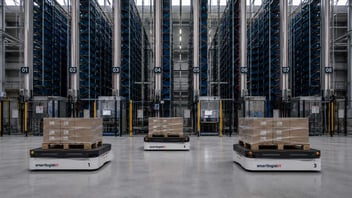
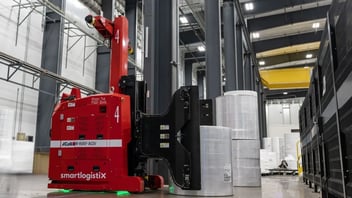
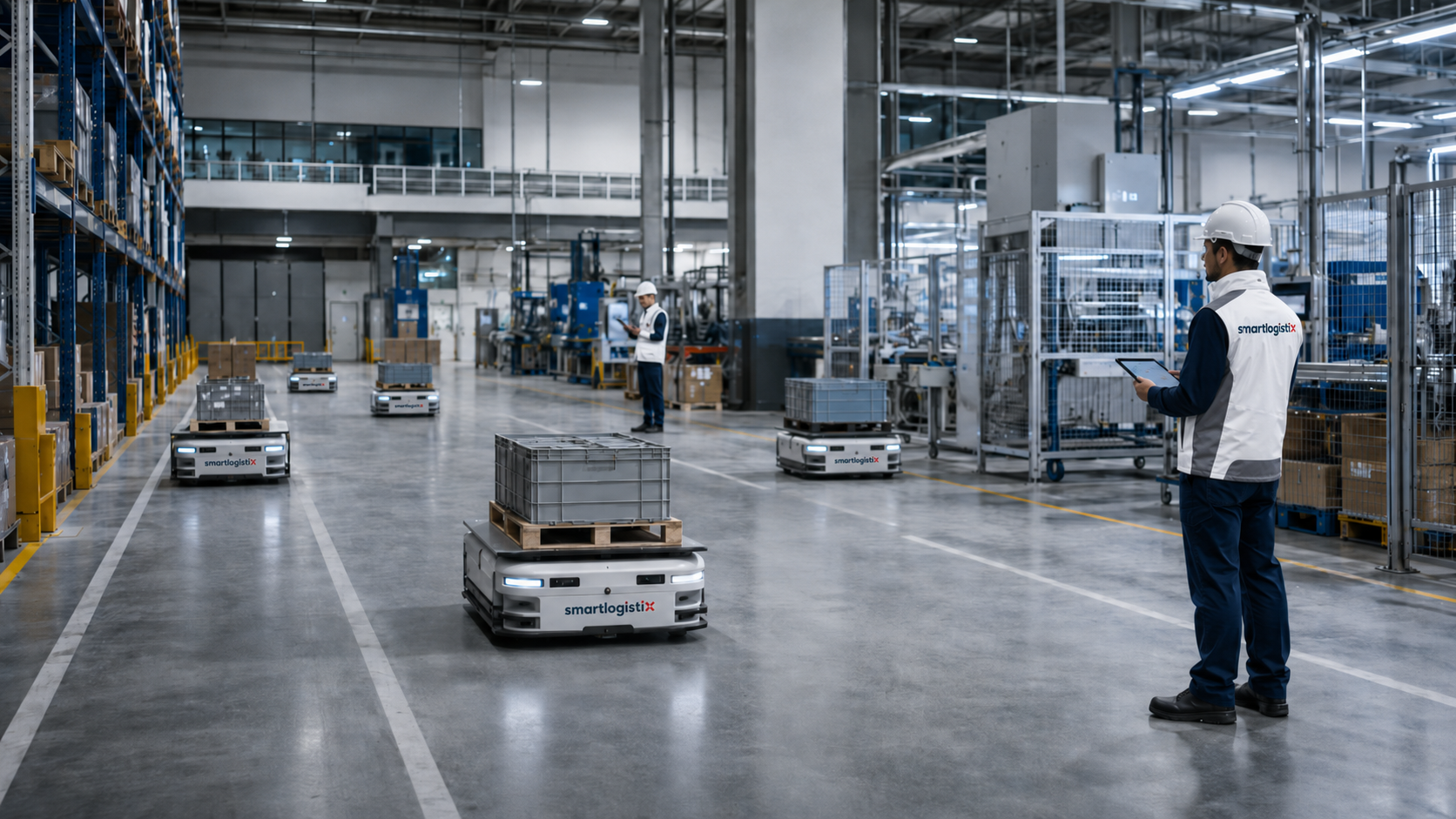
Integrated automation systems allow plants to redesign internal flows to stabilize outputs regardless of personnel availability. A fleet of AGVs (Automated Guided Vehicles) and AMRs (Autonomous Mobile Robots), supported by orchestration software, handles routine transfers, tracks warehouse flows, and integrates with production and warehouse management systems. These solutions continuously move materials, from raw materials to production, between departments, and toward the finished goods warehouse, reducing downtime and operating without breaks, fatigue, or performance variations.
Smartlogistix addresses this challenge with a range of Mobile Robots designed to meet concrete operational needs: from high-capacity platforms like TITAN for heavy load transport, to the versatile JUPITER and compact PLUTO models, capable of adapting to production seasonality, multi-shift operations, and complex facility layouts.
Real-world impact: Precision, compliance, and continuity
Imagine a secondary pharmaceutical packaging plant handling high-potency drugs. During peak demand, the manual transport of temperature-sensitive ingredients or sterilized vials between cleanrooms and packaging lines becomes a high-risk bottleneck. Any delay in material flow not only slows production but risks compromising batch integrity and regulatory compliance.
By implementing AMRs for these critical routes and integrating them with a real-time smartmes, the plant automates transfers within controlled environments. This level of automation is fundamental to meeting rigorous FDA 21 CFR Part 11 requirements, ensuring that every movement is recorded with total digital traceability.
This allows specialized operators to focus on high-value activities such as aseptic quality control, ensuring a contamination-free process, ready for any audit, and without interruptions.
Measuring the success of Human + Automation collaboration
An effective automation strategy does not just "turn on the robots": it aligns decisions, data, and people so that everyone contributes their best. Key success indicators include:
- Maintenance of production volumes despite staffing fluctuations
- Reduction in costs for overtime and temporary staff
- Improvement in on-time delivery rates
- Documented safety progress, with fewer accidents related to manual handling
How Smartlogistix supports your automation journey
Smartlogistix offers an integrated suite of solutions to enable a truly "smart factory" intralogistics, including:
- Mobile Robots: AGVs and AMRs designed for different load profiles and production environments, compliant with open standards like VDA 5050 for flexible fleet management.
- Automated Material Handling: transport, sorting, palletizing, and labeling systems designed to integrate seamlessly with existing lines.
- smartlogistix Software: a production logistics management platform that synchronizes end-of-line, warehouses (manual and automatic), and mobile fleets under a single digital direction.
- smartmes: a real-time MES system to align production planning and execution with material flows and performance indicators.
Together, these solutions help protect production capacity, simplify operations, and reduce the impact of labor volatility.
.jpg?width=960&height=480&name=Banner%20CONTACT%20US%20(5).jpg)