Internal material handling is one of the areas where automation can generate significant improvements in terms of operational continuity, efficiency and process quality. The real value emerges when material flows, production and warehouse operations are orchestrated within a single digital infrastructure.
At Smartlogistix, this integration is a fundamental principle: mobile robots, control software and logistics systems interact continuously, transforming material handling from an isolated activity into a structural component of the production process.
In this article you will discover:
- How synchronized flows improve operational stability
- How mobile robots increase safety and quality
- Why software integration is crucial in automation projects
- What effects automation has on routes, spaces, and layouts
- How data generated by automated systems supports continuous improvement
Stability of the production flow and reduction of waiting times
In manual or semi-automated handling, variability and micro-stoppages easily arise, slowing down the entire production cycle. When handling is entrusted to an automated system orchestrated by a software platform, the logic changes: robot missions are scheduled and reassigned based on the real production status, reducing waiting times, congestion and interference. This effect translates into greater operational continuity and a more predictable flow.
Safer, more predictable and more repeatable handling operations
Mobile robots make it possible to standardize the handling process more rigorously than traditional equipment. Sensors, navigation logic and controlled paths ensure greater repeatability of operations, reduce unauthorized deviations and minimize operational risks.
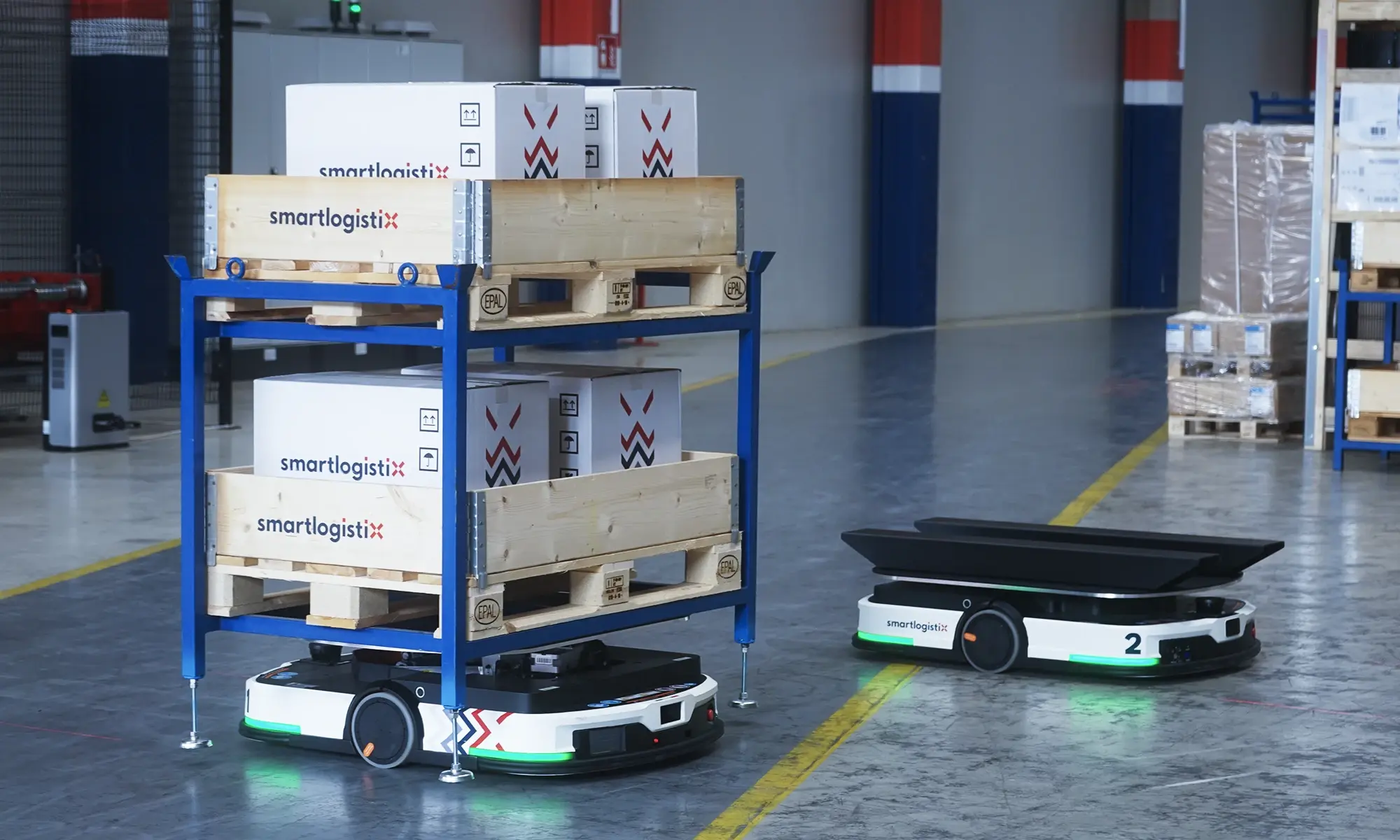
A concrete example is the AMR-X, designed for high-frequency horizontal flows. Its consistent functioning helps improve the overall quality of the logistics process and stabilize handling times.
Software integration as the main driver of efficiency
The real step-change is achieved when production, warehouse and mobile robots are managed through a single control logic. The software suite offered by Smartlogistix enables automatic missions to be launched based on real events, such as order progression or buffer saturation, ensuring alignment between physical and digital flows and minimizing manual interventions.
Integration is what allows automation to become a stable, measurable and adaptable asset over time.
Click here for a complete overview of the software solutions offered.
More efficient use of space and internal routes
Automation opens up new possibilities in layout design. With compact robots such as PLUTO COMPACT, it is possible to reduce corridor width, simplify routes and increase the smoothness of traffic even in facilities with significant structural constraints.
Rethinking material handling from an automation perspective makes it possible to make better use of available space and create more linear flows, improving productivity and safety.
Increase in operational safety
Thanks to controlled navigation protocols, automatic obstacle detection and intelligent speed regulation, automation significantly reduces the risk of accidents. An orderly environment, with assigned routes and predictable movements, allows operators to work more confidently and plants to maintain consistent operational standards.
More complete operational data and continuous optimization capabilities
Every mission, stop or deviation is recorded and converted into useful data for improving performance. Smartlogistix platforms make it possible to analyze these elements to identify bottlenecks, optimize robot workload, improve routing logic and support preventive maintenance strategies.
The availability of detailed information makes the process more transparent and enables faster and more accurate decision-making.
Conclusion: real value comes from system coherence
Internal material handling automation delivers concrete benefits when introduced as part of an integrated system capable of connecting robotics, software and operational processes. The Smartlogistix approach enables more stable flows, greater safety, more predictable processes and continuous optimization capability.
.jpg?width=1400&height=700&name=Banner%20CONTACT%20US%20(10).jpg)