The revamping of AGVs and AMRs: extending the life of handling systems
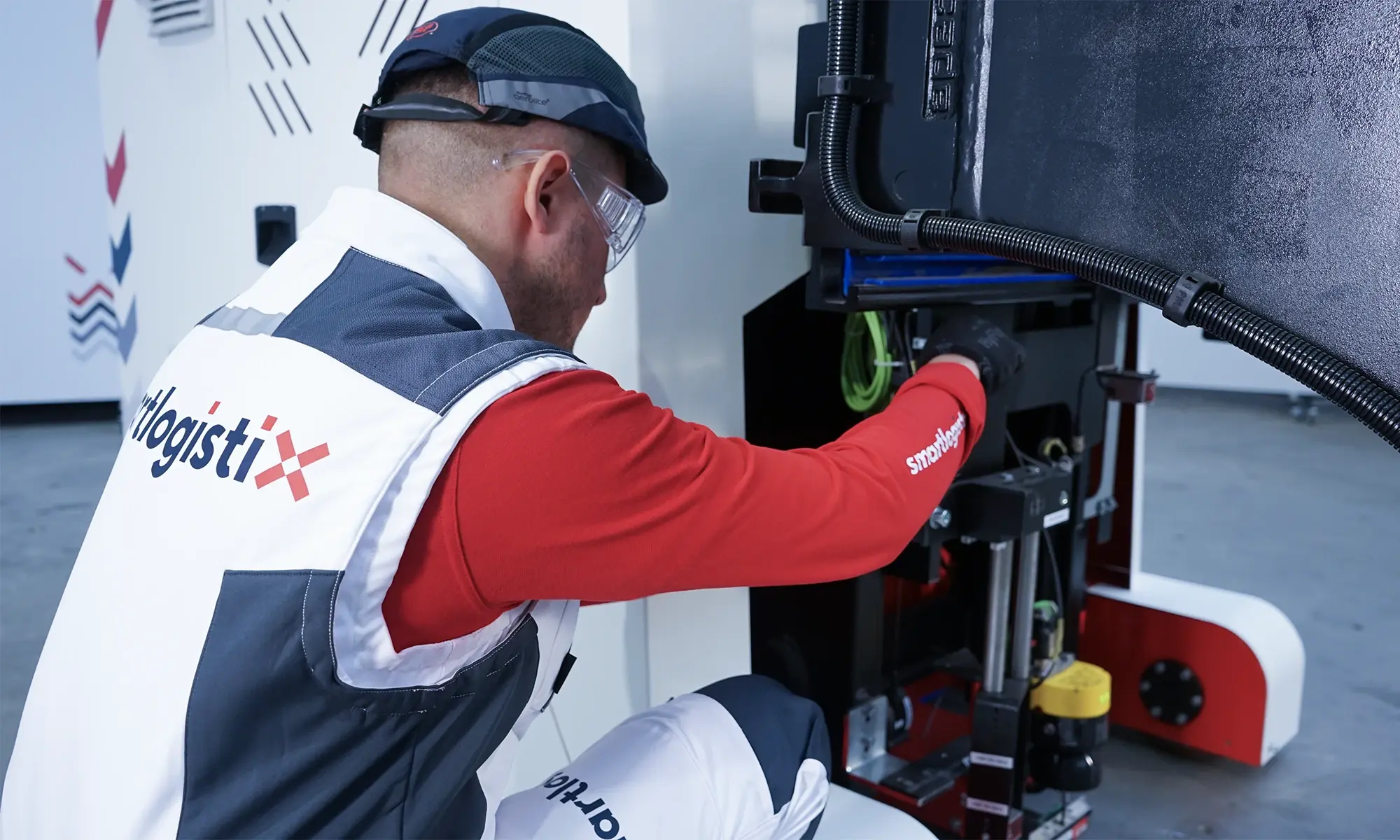
The revamping of AGVs and AMRs, namely the set of technical, software, and mechanical upgrade interventions carried out on existing vehicles, makes it possible to extend their useful life, increase efficiency, and integrate new digital technologies without starting from scratch.
For Smartlogistix, revamping is an integral part of the intralogistics automation strategy: a concrete solution to ensure operational continuity, interoperability, and sustainability of automated handling systems.
In this article you will discover:
- What revamping is and in which contexts it applies
- The operational and management benefits for companies
- How Smartlogistix manages a revamping project
- How revamping contributes to building an efficient and sustainable smart factory
What revamping means
The revamping of AGVs and AMRs differs from ordinary maintenance because it involves a complete requalification of automated vehicles, with the aim of improving performance, safety, and compatibility with modern supervision software for internal logistics.
The most common intervention areas include:
● Hardware retrofit, with the upgrade of motors, batteries, or sensors to more efficient and safer versions
● Software upgrades, introducing advanced control algorithms and predictive maintenance functions (features managed and coordinated by software such as Smart_Logistix, capable of integrating and monitoring all production and internal logistics flows in real time)
● IT/OT integration, to connect automated systems to supervision software (WMS, MES)
● Flow optimization, reducing cycle times and improving the regularity of movements
● Regulatory compliance
● Easy addition to te system of new-generation vehicles, which will coexist with the revamped vehicles
The operational benefits of revamping
Companies that adopt AGV and AMR revamping plans obtain concrete advantages in terms of performance, sustainability, and production continuity.
Here are the benefits provided by revamping:
1. Operational continuity
Revamping enables modular and scheduled interventions, avoiding long plant downtimes: the digitalization and progressive modernization of internal logistics systems make it possible to improve efficiency without interrupting production.
2. Increased efficiency and operational performance
Through the optimization of control software and the replacement of obsolete components, revamping makes it possible to improve flow regularity, reduce cycle times, and increase the availability of automated systems. The modernization of existing plants with modular and digital solutions increases productivity and energy efficiency without requiring new installations.
3. Reduced maintenance costs
The introduction of smart sensors and predictive maintenance logic reduces the risk of unexpected failures, containing costs and downtime.
4. Environmental benefits and circularity
Reusing and upgrading existing assets is an increasingly common practice to reduce the environmental impact of the logistics sector and extend the life cycle of equipment.
How Smartlogistix manages a revamping project
The Smartlogistix end-to-end approach covers the entire operational cycle of an AGV/AMR revamping project: analysis, design, implementation, and monitoring. Each intralogistics revamping project is managed in an integrated way, combining hardware, software, and consulting expertise to optimize the performance of existing automated solutions.
This approach makes it possible to obtain a more efficient, reliable and interoperable system, with a significant reduction of the total cost of ownership (TCO).
Revamping and the Smart Factory
Revamping is one of the most effective levers for evolving toward a smart factory, where automated and digital systems operate in synergy. In the Smartlogistix model, the modernization of AGVs and AMRs translates into:
● greater reliability of material flows
● real-time traceability of data and processes
● interoperability between facilities and software
● reduced consumption
● restoration and improvement of operating autonomy and energy cycles
Conclusion
The revamping of AGVs and AMRs is not just a technical intervention: it is an industrial strategy that makes it possible to improve efficiency, sustainability, and operational continuity of automated handling systems.
Thanks to an integrated approach that combines hardware, software, and consulting competencies, Smartlogistix supports companies in renewing and optimizing their fleets of autonomous vehicles, transforming them into modern, connected infrastructures ready for the challenges of Industry 4.0.
The main software functions in intralogistics
In the intralogistics landscape, software solutions are divided into several key functions:
Logistics management and device control
A central function is the coordination of warehouse operations (material movement, storage, picking) together with device control (conveyors, robots, automation). This way, decisions regarding goods remain integrated with physical operations.
Integration with business systems
The ability to interface with business information systems (ERP, planning systems, production systems) is essential: it ensures that logistics flows are aligned with business processes and that no data misalignments occur.
Synchronization with production
Another function consists of connecting internal logistics with production. Production processes, in fact, require the synchronization of material flows, order management, progress monitoring, and real-time traceability.
Central decision logic
Intralogistics operations benefit from a module that “decides” which task to assign to which resource, based on real-time inputs, operational constraints, and business strategies. This central logic ensures consistency and optimization in task assignment.
Analysis, reporting and visibility
A software component collects operational data, processes it, generates KPIs and dashboards to provide visibility into the performance of the intralogistics system, allowing corrective actions and improvements.
Supervision, simulation and digital model
Finally, there is the function of process supervision (real-time monitoring), the ability to simulate operational scenarios, and to adopt a digital model (digital twin) to predict the impact of changes before implementation.
Focus: WMS and WCS – the heart of intralogistics
WMS: the management pillar
The WMS is currently the most widespread software in logistics companies, as it provides the operational structure to control all warehouse activities: receiving, storage, picking, packing, shipping, inventory, and reporting.
A modern WMS:
● Dynamically manages storage locations (ABC rules, rotation zones)
● Supports picking strategies (lot, wave, batch)
● Interfaces with automatic identification devices (barcode, RFID)
● Provides real-time synoptics and dashboards
Click here for more information.
WCS / WES: the operational “traffic controller”
In warehouses with a high level of automation (conveyors, shuttles, robots, AGVs), a software layer is needed to translate the strategic tasks from the WMS into operational commands for the devices. This role is typically performed by the WCS or WES.
In many cases, the WMS “includes” WCS modules or communicates with an external WCS system.
| WMS – Warehouse Management System | WCS / WES – Warehouse Control / Execution System |
|
| Role | Controls warehouse operations: receiving, storage, picking, shipping and inventory. | Translates WMS tasks into operational commands for automated devices. |
| Key functions | Storage management, picking strategies, interface with barcode/RFID, real-time dashboards. | Coordinates conveyors, shuttles, robots and AGVs. |
| Relationship | The WMS may include or communicate with an external WCS system. | |
Integration with production: the role of the MES
The MES takes on the task of connecting the management level (ERP) with production execution, regulating in real time machine workloads, order progress, and synchronization of the warehouse with line consumption.
When WMS and MES are integrated, the company gains complete visibility over production, material consumption, supply needs, and order progress, with greater data consistency.
A best practice is to have middleware modules or APIs that ensure bidirectional data exchange between MES, WMS, and ERP, avoiding duplication or delays.
Click here for more information.
AGV / AMR fleet management
Automated vehicles (AGV, AMR) require a mission management module (fleet management) capable of:
● Assigning tasks (pick, transport, replenishment)
● Planning optimal routes while avoiding conflicts
● Monitoring operational status and diagnostics
● Interfacing with warehouse management systems
Middleware, supervision and data integration
An often-overlooked point is the platform that connects the various modules: ERP, WMS, MES, devices, IoT sensors. The middleware / integration layer performs critical functions:
● Translates different protocols (OPC UA, MQTT, REST API)
● Harmonizes data (mapping, normalization)
● Ensures proper latency and performance
● Provides data security and domain segregation
A well-designed architecture simplifies the adoption of analytics and digital twins in the long term.
Click here for more information.
Criteria for selecting the most suitable intralogistics software
When a company evaluates which software to adopt, several fundamental criteria are:
1) Scalability and modularity – ability to grow and add modules (WCS, fleet manager, analytics)
2) Interoperability / APIs – ease of integration with ERP, legacy systems, machines
3) Adaptability to the physical plant – compatibility with existing devices, robots, and systems
4) Performance and latency – real-time requirements, throughput
5) Maintainability and updates – updates, support, software evolution
6) Security and reliability – encryption, audit, user restrictions
7) Analysis and data visualization – dashboards, KPIs, advanced reporting
A careful assessment of these factors helps avoid “lock-in” errors or information silos.
Smartlogistix offering
Smartlogistix offers a suite that includes:
● WMS module with real-time tracking and intelligent storage strategies
● “Fleet management” module for robots, AGVs, and handling systems
● Interfaces with ERP, MES, and external machines
● Reporting, dashboards, and analytics for monitoring and continuous improvement
Thanks to its modularity and integration, the suite easily adapts to both existing and revamping plants, reducing reconfiguration costs.
Visit the Smartlogistix software solutions page for more details on specific modules and use cases.
Conclusion
Choosing intralogistics software is a strategic decision: having robots or physical automation alone is not enough if flows are not managed by consistent software logic. WMS, WCS, MES, fleet management, and middleware are the building blocks of an integrated ecosystem that turns internal logistics into a competitive advantage.
Smartlogistix solutions make it possible to automate and digitize production and intralogistics processes, integrating hardware, data, and people into a single modular platform designed to evolve over time along with business needs.