Few industries operate with such a narrow margin for error as the pharmaceutical sector. What leaves a production facility will eventually enter a patient’s body: a responsibility that alone explains why this is the most heavily regulated segment of the manufacturing world.
In this context, material handling is an integral part of the product quality chain. A misplaced batch, an unrecorded temperature deviation, or unauthorized access to a storage area are not minor incidents: each of them is classified as a non-conformity. And non-conformities have very tangible consequences, ranging from batch recalls and warning letters to direct risks for the patients who will ultimately take the medicine.
For this reason, regulatory pressure on these processes continues to increase. Facilities that fail to implement adequate traceability and control systems do not merely risk inefficiency; they expose themselves simultaneously on three fronts: regulatory, operational, and reputational.
The Regulatory Landscape: European and US Requirements
The regulatory framework governing logistics in pharmaceutical facilities is complex and constantly evolving in both Europe and the United States. Understanding it is the first step toward designing truly compliant intralogistics systems.
European and International Regulations
cGMP (current Good Manufacturing Practice) requires the documentation, traceability, and validation of every process that directly or indirectly affects product quality, including internal material handling. EU GMP Annex 11 and Annex 15 respectively regulate the validation of computerized systems and the qualification of facilities and equipment. GDP (Good Distribution Practice) extends control requirements to the cold chain for temperature-sensitive products, while the FMD (Falsified Medicines Directive) requires serialization and verification at individual pack level throughout the European supply chain.
Specific Requirements for the US Market (FDA)
The US market adds a further level of rigor. FDA 21 CFR Part 211 establishes explicit obligations for the receipt, storage, handling, and internal distribution of materials: every operation must be documented, batches must be segregated, and environmental conditions must be controlled and recorded. FDA 21 CFR Part 11 extends these requirements to digital systems, requiring automated audit trails, data integrity, access control, and verifiable electronic signatures, with direct application to any WMS, SCADA, or AGV control system.
The DSCSA (Drug Supply Chain Security Act), fully operational since 2023, introduces mandatory serialized traceability at saleable-unit level throughout the supply chain. USP <1079> guidelines define standards for environmental control during storage and handling. Finally, the FDA Data Integrity Guidance of 2018 reinforces the ALCOA+ principles already adopted internationally for the quality of data generated by digital systems in GMP environments: a non-compliant WMS or SCADA system can expose a company to import alerts or warning letters.
It is also worth noting that the European (EMA) and US (FDA) frameworks have strengthened mutual recognition of GMP inspections, while retaining regulatory differences. For manufacturers operating in, or planning to enter, the US market, FDA compliance is not optional: it is a prerequisite for export.
Operational Challenges in Pharmaceutical Intralogistics
Understanding the regulatory framework is not enough without addressing the operational level. Without automation, ensuring compliance and safety within the facility becomes a continuous, costly, and fragile effort. These are the most common critical issues we encounter in pharmaceutical plants.
Managing Temperature-Controlled Areas
Handling temperature-sensitive products such as vaccines, biologics, and APIs (active pharmaceutical ingredients) requires operations in refrigerated environments, often between 2 and 8°C, down to -20°C or below depending on the product. Without automation, this requires the continuous presence of personnel in extreme conditions. Workers may be limited to 30- to 60-minute shifts followed by mandatory recovery breaks, generating high operating costs and health risks that the company must manage and document.
Vehicles are also exposed to risk. Conventional forklifts are not designed for continuous operation at extreme temperatures, leading to accelerated degradation of mechanical components and batteries. The most critical risk, however, concerns the product’s thermal integrity: every movement of personnel between refrigerated and ambient-temperature areas requires door openings that create temperature fluctuations. These events are difficult to document in real time and represent one of the main sources of cold-chain deviation.
Traceability and the Risk of Human Error
In manual processes, batch traceability depends on scanning, paper-based records, or data entry, all of which are vulnerable to human error. In a GMP environment, missing or incorrect data is treated as evidence that an activity was not performed. Incomplete audit trails, or records that cannot be defended during an inspection, expose the company to regulatory scrutiny.
Batch Management, Segregation, and System Validation
The pharmaceutical industry requires strict expiry-based inventory management using FEFO logic (First Expired, First Out). Without a centralized system, the risk of incorrect picking is high, with direct consequences for batch quality and compliance. At the same time, any software used in pharmaceutical operations, including WMS, SCADA, and AGV fleet management systems, must be validated in accordance with GAMP 5 guidelines for Computer System Validation, a process that requires structured documentation and a dedicated methodology.
Smartlogistix Solutions for the Pharmaceutical Industry
Smartlogistix addresses these challenges through an integrated ecosystem of hardware and software solutions, covering the entire process from design to validation.
Smartlogistix WMS: The Core of Traceability
The Smartlogistix ecosystem works in close integration with the WMS, which coordinates the entire material flow within the facility, from raw-material receiving to finished-product shipping. In pharmaceutical applications, this means rigorous batch management with automated FEFO logic, a complete audit trail for every movement in compliance with FDA 21 CFR Part 11, and integration with corporate ERP platforms and all OT systems installed on the production line.
The system supports the Computer System Validation (CSV) process by generating the required documentation, including IQ, OQ, and PQ, while ensuring end-to-end traceability from the raw-material batch to the packaged finished product. Smartlogistix adopts a modular, vendor-agnostic open-platform architecture based on open standards and universal communication protocols, making integration with third-party systems easier.
SCADA for Pharmaceutical HVAC: Product-Level Cold-Chain Traceability
For environmental-condition management, Smartlogistix offers a specialized SCADA module for HVAC systems in pharmaceutical and food-processing environments. Unlike standard environmental monitoring systems, this SCADA can associate environmental data with specific storage units and logistics entities, including batches and locations, making it possible to reconstruct the complete thermal history.
The system provides continuous real-time monitoring, automatic alarms in the event of temperature deviations, a complete historical record, and compliance with GDP guidelines and facility qualification requirements, including DQ, IQ, OQ, and PQ. Every temperature reading is recorded automatically and can be verified, eliminating reliance on manual checks and minimizing the risk of documentation gaps.
AGVs and AMRs for Refrigerated Environments: Removing the Human Factor from the Cold Chain
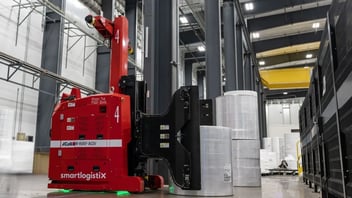
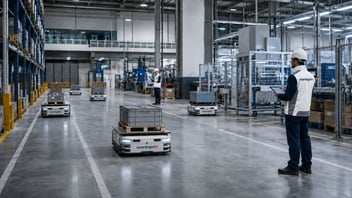
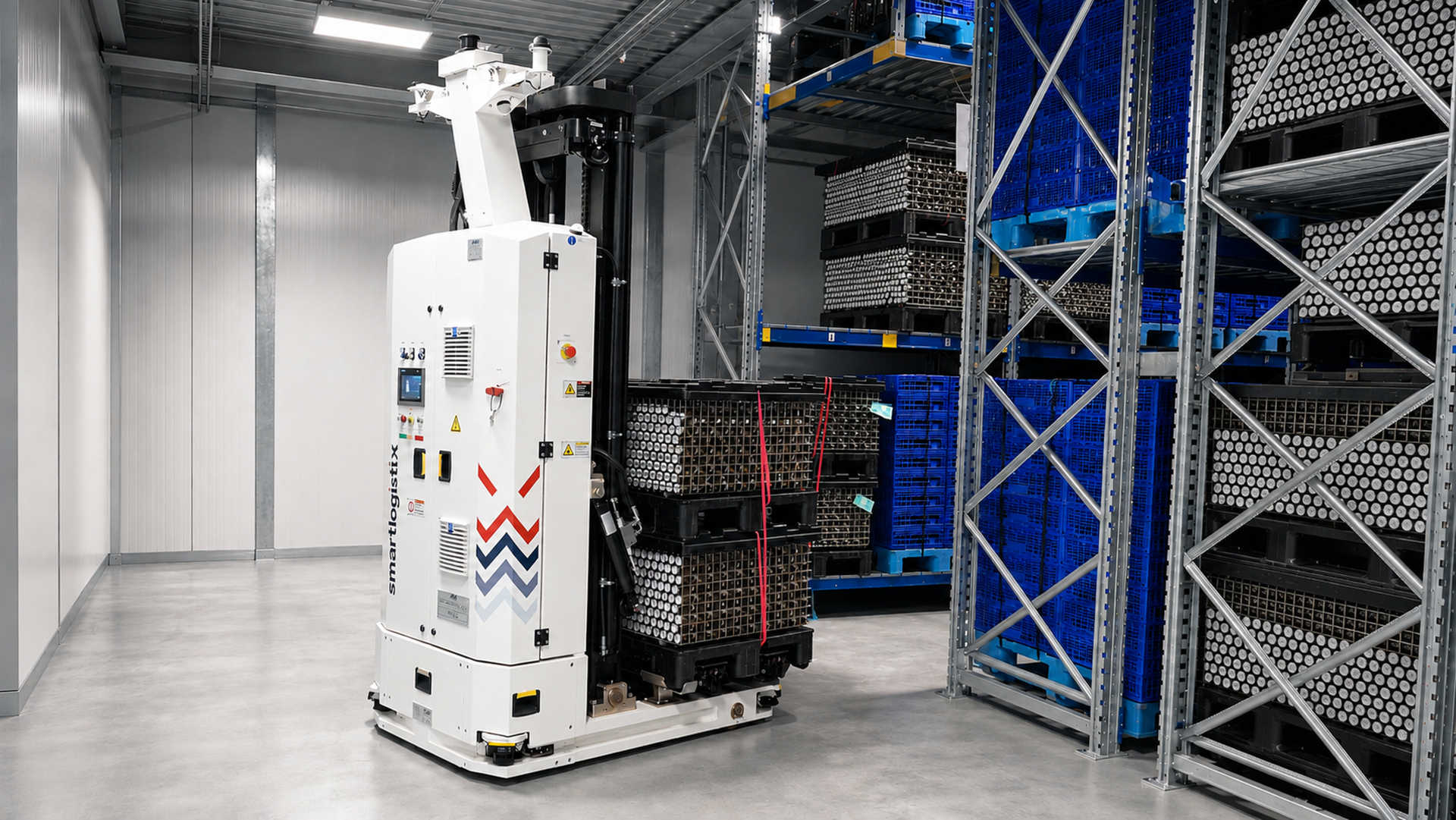
The most effective response to the challenges of temperature-controlled areas is to eliminate the need for personnel to operate inside them. Smartlogistix supplies AGV (Automated Guided Vehicle) and AMR (Autonomous Mobile Robot) fleets selected and configured specifically for operation in sub-zero environments, with certified 24/7 performance down to -25°C, without interruptions, shift limitations, or health risks for workers.
Every movement performed by the AGVs is automatically recorded in the WMS, ensuring continuous traceability without human intervention. Eliminating personnel movement between refrigerated and ambient-temperature zones dramatically reduces uncontrolled door openings and, consequently, the risk of thermal exposure affecting the products.
The solutions comply with the VDA 5050 standard, ensuring interoperability with other automated systems within the facility.
The Smartlogistix portfolio includes solutions such as TITAN for heavy-load handling, JUPITER for versatile applications in compact spaces, and PLUTO for line-side logistics. Each solution can be adapted to the specific storage and handling requirements of pharmaceutical facilities.
Automated Temperature-Controlled Warehouses
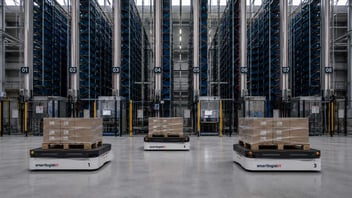
For high-density storage facilities, Smartlogistix provides automated warehouse solutions such as miniload systems, stacker cranes, and shuttle systems. These can be integrated with the WMS and qualified in accordance with GMP requirements. They optimize available space, ensure physical batch segregation, and eliminate picking errors, removing one of the primary causes of non-conformity in pharmaceutical warehouses.
A Validatable Approach: From Design to Compliance
Supplying technology is not enough in a regulated environment such as the pharmaceutical industry. Smartlogistix supports customers throughout the complete validation process required by GMP regulations, from the definition of User Requirements Specifications through to equipment and facility qualification activities.
The adoption of open, non-proprietary platforms, one of the pillars of the Smartlogistix approach, facilitates both regulatory audits and integration with existing systems.
For facilities already in operation, Smartlogistix also provides retrofitting and system-upgrade services, enabling existing infrastructure to be brought into line with GMP standards without requiring complete replacement.
This approach is supported by a customer base that includes some of the world’s leading pharmaceutical companies, demonstrating Smartlogistix’s ability to operate in enterprise environments with top-tier regulatory requirements.
Conclusion: Turning Compliance into a Competitive Advantage
When managed with the right technologies, regulatory compliance stops being merely a cost and becomes an operational advantage. A pharmaceutical facility equipped with complete traceability, an automated cold chain, and digital audit trails operates faster, offers stronger product-quality assurance, and competes more effectively in international markets.
Smartlogistix provides the technical expertise, solution portfolio, and methodology required to design or upgrade intralogistics systems that meet these standards.
Contact us for an assessment of your facility’s specific requirements and to identify the most effective path toward automation and compliance.
.jpg?width=960&height=480&name=Banner%20CONTACT%20US%20(1).jpg)