From AI-driven orchestration to industrial cybersecurity: how the "Smart Factory" is redefining the limits of intralogistics.
The warehouse is no longer a static storage facility or a simple "black box" for inventory. It has evolved into a high-speed, hyper-connected ecosystem where the boundaries between production, storage, and distribution have effectively dissolved. For industries like nonwovens, paper, and FMCG, where throughput is measured in seconds and a single error can compromise tons of material, staying competitive means moving beyond basic automation.
Market data suggests that we have hit a critical maturation point. The "experimental" phase of Industry 4.0 is over. We are moving away from isolated "gadgets" and toward integrated, disciplined ecosystems. Here are the five pillars reshaping intralogistics this year and why they are essential for your facility’s survival.
1. AI-Powered Warehouse Intelligence & Dynamic Orchestration
Today, Artificial Intelligence has officially moved from a "nice-to-have" analytics tool to the central nervous system of the plant. The shift is from predictive (telling you what might happen) to agentic (taking action to ensure the best outcome).
The End of Rigid Rules
Traditional warehouse software operates on "if-then" logic. If a pallet arrives, then move it to the nearest open slot. AI-driven systems, however, perform Dynamic Task Sequencing. They don't just follow static rules; they weigh thousands of variables simultaneously, seeking the closest-to-optimal solution:
- Real-time carrier cutoff times.
- Current battery levels and location of every AMR/AGV in the fleet.
- Unscheduled Peak production on Line 4.
- Labor availability in the picking zone.
Why it matters
By analyzing these variables, the system automatically reprioritizes missions. If a high-priority shipment is delayed at the dock, the AI can instantly re-route robotic assets to clear a different bottleneck, ensuring that the most urgent orders move first. This eliminates the "micro-bottlenecks" that human planners, limited by the speed of manual data entry, simply cannot catch in real time.
2. Digital Twins: The "Simulation-First" Industrial Strategy
One of the most significant strategic shifts this year is the death of "guesswork." Today, no major hardware change happens without a digital rehearsal. This is the era of the Digital Twin and Digital Mirror SW.
Beyond 3D Models
A Digital Twin is not just a 3D render of your warehouse; it is a high-fidelity virtual mirror connected to live IoT data. It understands the physics of your facility: the weight of your rolls, the speed of your conveyors, and the friction of your floors.
Strategic Advantage
Before a single piece of hardware is installed, managers run "what-if" scenarios:
- “How will our AGV traffic flow change if we add a third packaging line next month?”
- “Can our current racking layout handle a 20% increase in SKU variety?”
- “What is the impact of a 15-minute power flicker on our sortation logic?”
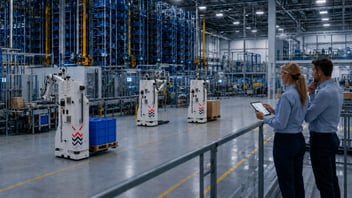
Today, these twins are "live". Operators can overlay predicted performance data against actual results on their tablets, identifying exactly where the physical reality is diverging from the digital plan. This allows for proactive adjustments before a minor deviation becomes a major shutdown.
3. The Convergence of AMRs and AGVs: Unified Fleet Orchestration
The long-standing debate of "AGV vs. AMR" has reached a conclusion in 2025: Hybridization. The line between these two technologies has blurred into a unified robotic fleet managed by a single orchestrator.
Specialized Roles in a Single Workflow
Modern warehouses are now deploying hybrid fleets where each asset plays to its strengths:
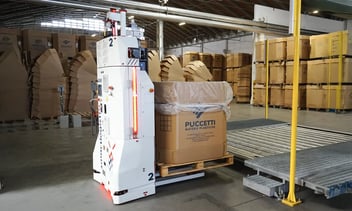
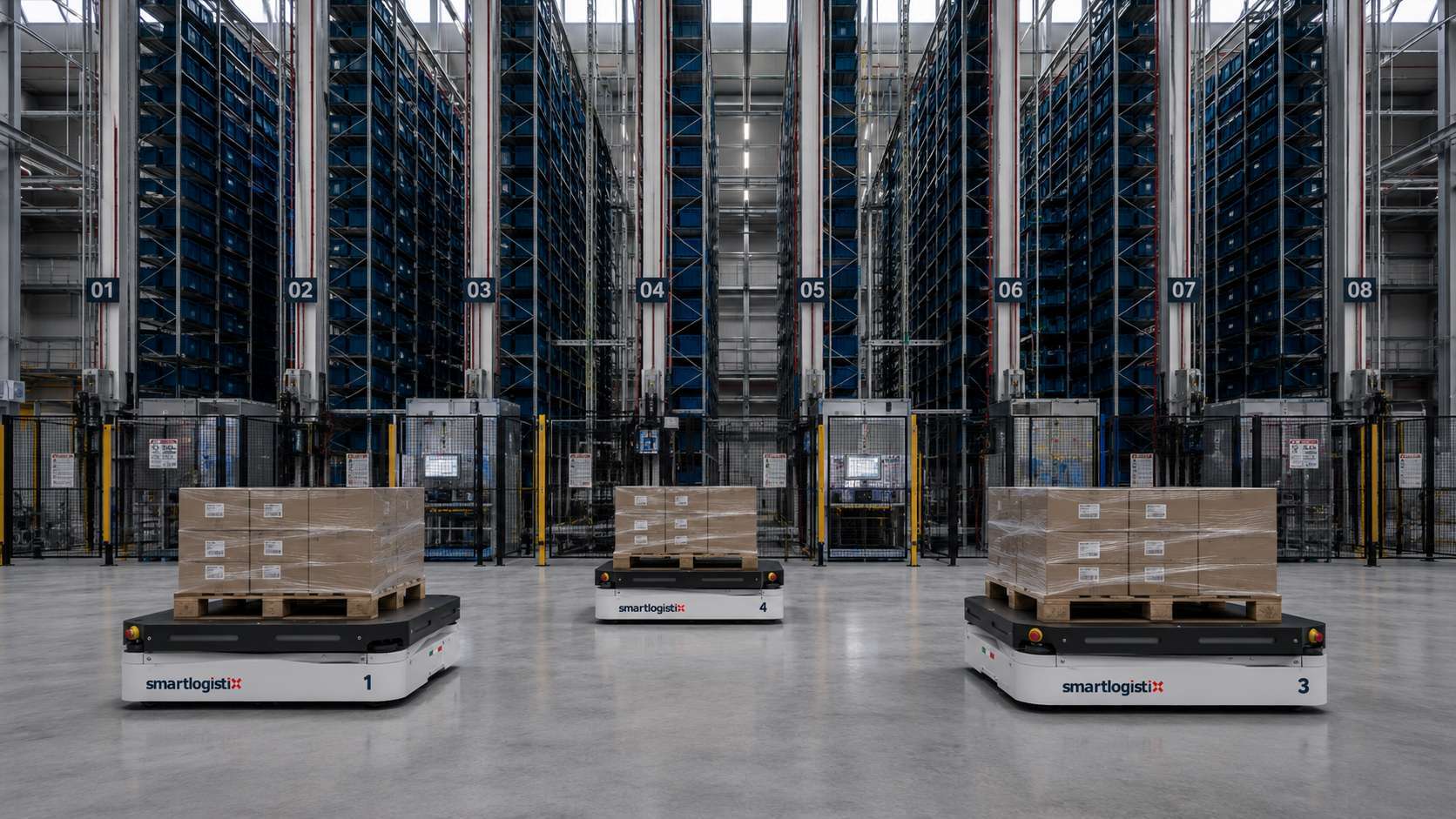
- AGVs (Automated Guided Vehicles): These remain the "heavy lifters." They follow high-volume, repetitive paths - such as moving massive 3-ton nonwoven rolls from the end-of-line to long-term storage.
- AMRs (Autonomous Mobile Robots): These are the "nimble navigators." They handle complex picking zones and "last-meter" deliveries to packaging stations, navigating around people and obstacles without needing dedicated paths.
The Power of Orchestration
The magic happens in the software layer. Today, you no longer need two separate software packages to manage these robots. A unified fleet manager synchronizes them as part of a single, cohesive workflow. If an AMR detects an obstruction in a shared aisle, it communicates that data to the AGVs behind it, allowing the entire fleet to adapt their routes simultaneously.
4. Industrial Cybersecurity: Transitioning to the Zero-Trust Era
As warehouses become more connected, the "attack surface" for cyber threats expands exponentially. A single compromised IoT device could, in theory, shut down an entire production line. Today, Industrial Cybersecurity is no longer a sub-category of IT; it is a core pillar of operational safety.
The Zero-Trust Architecture
The industry has moved toward the "Zero-Trust" model. The name says it all: no device, whether it’s a high-end PLC or a basic temperature sensor, is trusted by default.
- Identity-Based Access: every robotic arm and AGV must "handshake" with the network using encrypted certificates before receiving instructions.
- Micro-Segmentation: the warehouse network is divided into small "cells." If a breach occurs in the office Wi-Fi, the "firewall" between the office and the AGV fleet ensures the robots continue to work safely and autonomously.
For Smartlogistix, cybersecurity is a design requirement. We ensure that your intellectual property, namely your production speeds, your recipes, and your inventory data, is encrypted at the source and remains invisible to outside threats.
5. IoT-Enabled Real-Time Visibility and Predictive Maintenance
The Internet of Things (IoT) has finally achieved "blanket coverage" in the modern warehouse. Every pallet, every forklift, and every motor has become a data point. This has moved us from "knowing where things are" to "knowing how things are feeling."
100% Inventory Accuracy
Through the integration of advanced sensors and RFID gateways, "manual cycle counting" is becoming a relic of the past. The WMS maintains a real-time ledger that is 99.9% accurate, updated every time a pallet moves an inch.
The Rise of Predictive Maintenance (PdM)
The most valuable application of IoT today is Predictive Maintenance. Sensors monitor:
- Vibration Analysis: detecting early bearing wear in a stacker crane.
- Thermal Imaging: monitoring for hotspots in electrical panels.
- Acoustic Sensors: mistening for the "hiss" of a pneumatic leak that is inaudible to the human ear.
By alerting the maintenance team to potential wear-and-tear weeks before a breakdown occurs, companies are virtually eliminating "unplanned downtime". In a high-throughput facility, avoiding a 4-hour shutdown can save tens of thousands of euros in a single afternoon.
Smartlogistix: Engineering the Future of Your Warehouse
As a new reality in the intralogistics landscape, Smartlogistix was built to turn these five technologies into a tangible competitive advantage. We don't believe in technology for technology's sake; we believe in engineered efficiency.
Our solutions are designed to bridge the gap between the production line and the shipping dock, creating a seamless flow of data and material. Our turnkey systems include:
High-Density AS/RS (Automated Storage and Retrieval Systems)
We maximize your vertical space, using intelligent stacker cranes and multi-level shuttle systems that integrate natively with your production output.
Automatic Truck Loading Systems (ATLS)
The "final frontier" of automation. Our systems bridge the gap between the warehouse and the dock, loading trailers in minutes with zero manual intervention, perfectly synchronized with your WMS and shipping planner SW.
Native Software Ecosystem
Unlike "legacy" suppliers, our software is built for the modern era. It is modular, AI-ready, and features native integration for both AGVs and AMRs, providing you with a single "Point of Truth" for your entire operation.
Is your warehouse ready for today's challenges?
The window for "wait and see" has closed. The leaders of tomorrow are those who are building their digital infrastructure today. Don't let outdated material handling and fragmented software slow down your growth.
Discover how the Smartlogistix ecosystem can optimize your space, increase your speed, and secure your operations for the next decade.
Contact our automation specialists today to schedule a strategic audit of your facility and start simulating the future of your plant.
.jpg?width=960&height=480&name=Banner%20CONTACT%20US%20(8).jpg)

-1.webp?width=352&name=COPERTINA-news%20(2)-1.webp)