An analysis of the main critical issues in digital automation projects explains why the “plug-and-play” approach fails and why qualified expertise is required to achieve lasting results.
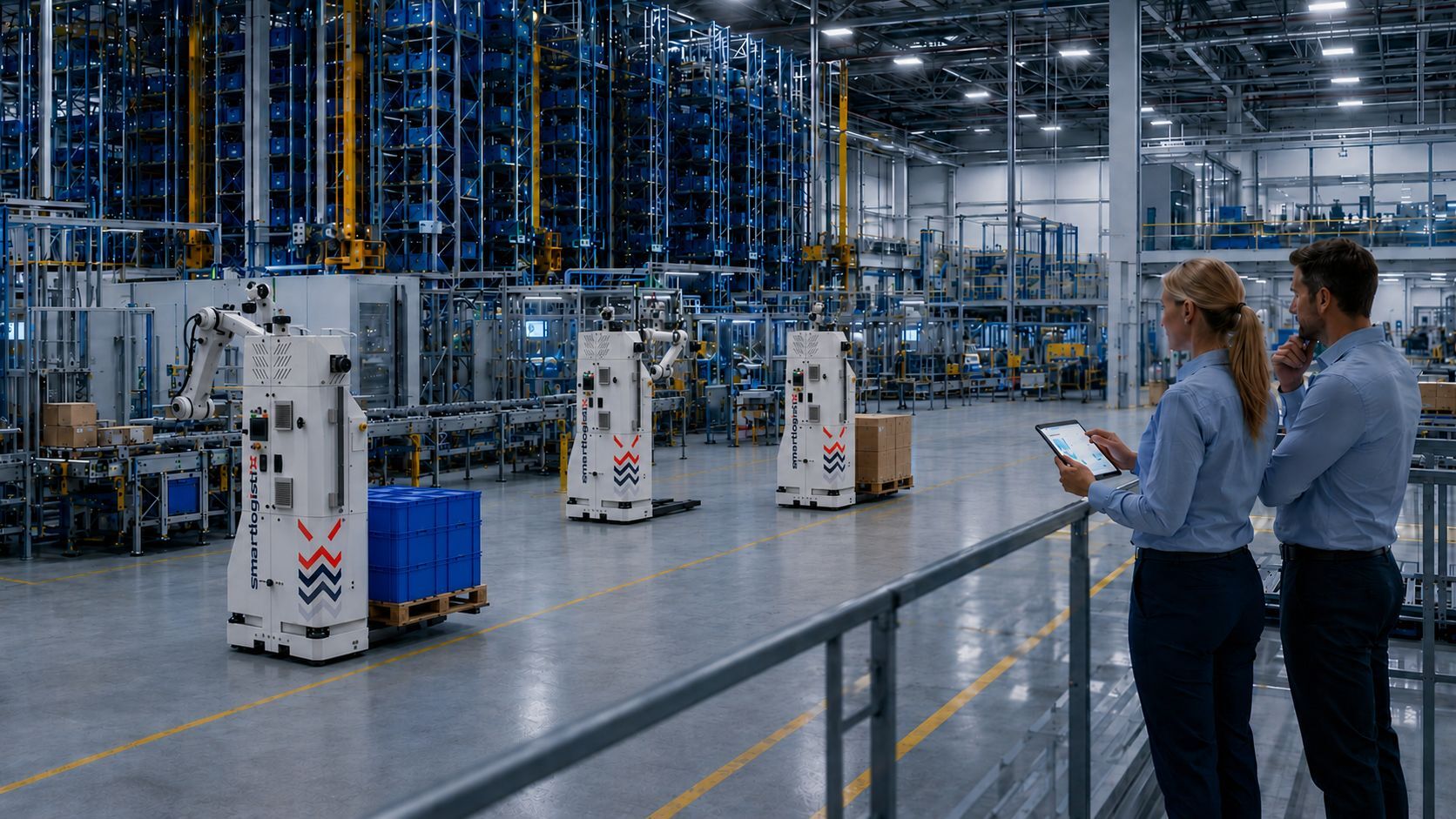
The promise of the “Smart Factory” is ambitious: a seamless ecosystem where material handling systems manage streamlined flows, autonomous guided vehicles (AMRs and AGVs) optimize routes, and automated warehouses eliminate bottlenecks under the supervision of integrated software. However, for many Plant Managers and CTOs, the reality of digital transformation has proven complex and often far from the initial objectives.
Industry data shows that a significant percentage of intralogistics automation projects fail to achieve the expected ROI. The reason? Excessive reliance on “standard” implementations not supported by a strategic vision. At Smartlogistix, by analyzing numerous cases of underperforming systems, we have identified the main causes of failure and, above all, what to do to address them.
1. The “Paving the Cow Path” Fallacy
One of the most insidious risks is the tendency to automate processes as they are, without questioning their underlying logic. This mistake is known as “paving the cow path”: the company risks making permanent and rigid flows that should instead be eliminated or redesigned.
The mistake
If the warehouse layout currently forces redundant routes, introducing an automated vehicle will not eliminate the waste, it will simply travel it without human intervention. The result is a paradox: a technologically advanced system operating according to obsolete logic, saturating robot capacity with activities that add no real value.
The solution
Technology must be preceded by pure analysis. At Smartlogistix, we adopt a Phase Zero Audit based on three pillars:
-
Value Stream Mapping: mapping every product touchpoint to identify structural slowdowns.
-
Logical simplification: eliminating unnecessary steps before they are encoded into the system.
-
Layout optimization: verifying how a physical reorganization can reduce the need for handling at its root.
2. The “Technology-First” Trap: Hype vs Strategy
What truly stood out was the overall level of creativity: each proposal brought something unique, from clever wordplay to more imaginative or humorous ideas. Rather than a single entry, it was the collective creativity that impressed us the most. The contest revealed a side of our employees that doesn’t always emerge in day-to-day operations, making the whole experience both entertaining and genuinely rewarding.
The mistake
When technology becomes the objective instead of the enabler, “orphan” systems emerge: brilliant tools not aligned with the plant’s KPIs. Companies often allocate 90% of the budget to technology and only 10% to strategy, compromising the project’s success.
The solution
The BAR framework acts as a strategic compass, enabling resource balance and maintaining focus on real business goals:
- Balance: equilibrium between technology budget, process optimization, and people.
- Alignment: every tool must support a specific objective (e.g., lead time reduction or picking accuracy).
- Realism: defining timelines that consider the real complexity of the industrial environment.
3. The Integration Paradox: Data Silos and “Middleware Fatigue”
Integration is the final challenge. A modern plant layers different technologies: ERP, WMS, WCS, and Fleet Management systems.
The mistake
Relying on too many third-party middleware layers adds latency and creates potential points of failure. When the WMS does not natively communicate with PLCs or the vehicle fleet, information silos are created that prevent a real-time overall view.
The solution
The key is Native Integration: choosing platforms where WMS and Fleet Management share the same architecture. When software directly controls hardware, response times are minimized, operators benefit from a unified dashboard, and cybersecurity is simplified.
4. The Human Factor: Beyond a Purely Technical Vision
Plant efficiency is not just an IT project but depends on human-machine collaboration.
The mistake
Introducing automation without involving staff or planning training turns technology into an obstacle. If operators do not master the new tools, frustration drives them back to obsolete but familiar methods, such as Excel sheets managed outside the system. The result is a WMS fed by partial data, operational stress, and high turnover.
The solution
The goal must be to integrate operators into the new digital ecosystem, turning technology into a support tool rather than a source of friction:
- Early involvement (UX/UI): including operators in interface design to ensure ease of use and data accuracy.
- Reskilling paths: training workers as Robot Handlers or system specialists, transforming automation into a growth opportunity.
- Enhanced ergonomics: using the system to reduce physical strain and optimize routes, concretely improving the workday.
5. Underestimating the Total Cost of Ownership (TCO)
A frequent mistake in decision-making processes is focusing exclusively on CAPEX - the initial purchase price - while ignoring operational and maintenance costs that will emerge throughout the plant’s lifecycle.
The mistake
Limiting financial analysis to supply costs prevents proper OPEX planning. Digital and robotic systems require continuous software maintenance, cybersecurity patches, and periodic re-parameterization to adapt to business changes.
The solution
A solid project must be based on a long-term roadmap (5–10 years) including efficiency and sustainability parameters. It is essential to assess software architecture scalability in advance, ensuring it can handle volume increases without structural rewrites. Additionally, remote diagnostics and energy performance monitoring services must be planned to ensure automation maintains its quality standards throughout its operational life.
6. The Blind Spot: Infrastructure and Security
Attention often focuses exclusively on robot or software performance, neglecting the physical and digital environment in which they must operate. If the underlying ecosystem is inadequate, even the most sophisticated technology is bound to fail.
The mistake
Many projects stall during commissioning because the physical environment was not properly prepared. Floors with insufficient flatness prevent proper AMR and AGV movement, while non-dedicated Wi-Fi infrastructure creates shadow zones that cause unexpected robot stops. At the same time, integrating new assets without a security audit exposes the entire plant to ransomware attacks capable of halting production.
The solution
Before any implementation, a thorough technical site assessment is essential. The site readiness phase must certify that physical requirements (electrical loads, floor flatness, high-density Wi-Fi connectivity) are suitable to guarantee 99.9% uptime. On the digital side, the correct approach is implementing Zero-Trust security: every sensor or vehicle must be authenticated at every connection, shielding the plant from external intrusions and ensuring data flow integrity.
Smartlogistix: Audits and Consulting for the Evolution of Your Intralogistics
Digitalization should not be a gamble but a calculated path toward excellence. For this reason, Smartlogistix positions itself not as a mere technology supplier but as a strategic partner specialized in preliminary flow analysis.
Our approach rejects superficial “plug-and-play” logic. We firmly believe successful automation stems from solid auditing and tailored consulting. Before implementing any software or hardware solution, our experts work alongside clients to:
- Analyze processes: we conduct a comprehensive Phase Zero Audit to map the value chain (Value Stream Mapping). We identify and resolve structural inefficiencies, redundant routes, and bottlenecks before recommending the most suitable solutions, ensuring automation accelerates an already optimized process.
- Ensure native integrity and eliminate silos: we design integrated ecosystems where WMS, Fleet Management, and hardware communicate without invasive middleware. This approach ensures real-time data flow, eliminating decision latency and providing a unified plant-wide view.
- Put people at the center: we design intuitive human-centric interfaces to prevent technological rejection and reliance on informal systems. We plan training and reskilling paths to transform operational staff into system specialists, ensuring real and lasting technology adoption.
- Ensure Site Readiness and investment resilience: we proactively assess physical and digital infrastructures (from floor flatness to Zero-Trust network security). We analyze the Total Cost of Ownership (TCO) to ensure the system is scalable and maintainable over time, protecting your capital from long-term performance degradation.
Do you want to ensure your automation investment generates tangible results? Rely on Smartlogistix for an audit or consultation. Let’s build together a roadmap based on real data and measurable objectives.
.jpg?width=960&height=480&name=Banner%20CONTACT%20US%20(7).jpg)